Potential
Integer factorization, which underpins the security of public key cryptographic systems, is believed to be computationally infeasible with an ordinary computer for large integers if they are the product of few prime numbers(e.g., products of two 300-digit primes).[15] By comparison, a quantum computer could efficiently solve this problem using Shor's algorithm to find its factors. This ability would allow a quantum computer to decrypt many of the cryptographic systems in use today, in the sense that there would be a polynomial time (in the number of digits of the integer) algorithm for solving the problem. In particular, most of the popular public key ciphers are based on the difficulty of factoring integers or the discrete logarithmproblem, both of which can be solved by Shor's algorithm. In particular the RSA, Diffie-Hellman, and elliptic curve Diffie-Hellmanalgorithms could be broken. These are used to protect secure Web pages, encrypted email, and many other types of data. Breaking these would have significant ramifications for electronic privacy and security.
However, other cryptographic algorithms do not appear to be broken by those algorithms.[16][17] Some public-key algorithms are based on problems other than the integer factorization and discrete logarithm problems to which Shor's algorithm applies, like theMcEliece cryptosystem based on a problem in coding theory.[16][18]Lattice-based cryptosystems are also not known to be broken by quantum computers, and finding a polynomial time algorithm for solving thedihedral hidden subgroup problem, which would break many lattice based cryptosystems, is a well-studied open problem.[19] It has been proven that applying Grover's algorithm to break a symmetric (secret key) algorithm by brute force requires time equal to roughly 2n/2 invocations of the underlying cryptographic algorithm, compared with roughly 2n in the classical case,[20] meaning that symmetric key lengths are effectively halved: AES-256 would have the same security against an attack using Grover's algorithm that AES-128 has against classical brute-force search (see Key size).Quantum cryptography could potentially fulfill some of the functions of public key cryptography.
Besides factorization and discrete logarithms, quantum algorithms offering a more than polynomial speedup over the best known classical algorithm have been found for several problems,[21] including the simulation of quantum physical processes from chemistry and solid state physics, the approximation of Jones polynomials, and solving Pell's equation. No mathematical proof has been found that shows that an equally fast classical algorithm cannot be discovered, although this is considered unlikely.[22] For some problems, quantum computers offer a polynomial speedup. The most well-known example of this is quantum database search, which can be solved byGrover's algorithm using quadratically fewer queries to the database than are required by classical algorithms. In this case the advantage is provable. Several other examples of provable quantum speedups for query problems have subsequently been discovered, such as for finding collisions in two-to-one functions and evaluating NAND trees.
Consider a problem that has these four properties:
  1. The only way to solve it is to guess answers repeatedly and check them,
  2. The number of possible answers to check is the same as the number of inputs,
  3. Every possible answer takes the same amount of time to check, and
  4. There are no clues about which answers might be better: generating possibilities randomly is just as good as checking them in some special order.
An example of this is a password cracker that attempts to guess the password for anencrypted file (assuming that the password has a maximum possible length).
For problems with all four properties, the time for a quantum computer to solve this will be proportional to the square root of the number of inputs. It can be used to attack symmetric ciphers such as Triple DES and AES by attempting to guess the secret key.[23]
Grover's algorithm can also be used to obtain a quadratic speed-up over a brute-force search for a class of problems known as NP-complete.
Since chemistry and nanotechnology rely on understanding quantum systems, and such systems are impossible to simulate in an efficient manner classically, many believequantum simulation will be one of the most important applications of quantum computing.[24] Quantum simulation could also be used to simulate the behavior of atoms and particles at unusual conditions such as the reactions inside a collider.[25]
Quantum supremacy
Main article: Quantum supremacy
John Preskill has introduced the termquantum supremacy to refer to the hypothetical speedup advantage that a quantum computer would have over a classical computer in a certain field.[26]Google has announced that it expects to achieve quantum supremacy by the end of 2017, and IBM says that the best classical computers will be beaten on some task within about five years.[27] Quantum supremacy has not been achieved yet, and skeptics like Gil Kalai doubt that it will ever be.[28][29] Bill Unruh doubted the practicality of quantum computers in a paper published back in 1994.[30] Paul Davies pointed out that a 400-qubit computer would even come into conflict with the cosmological information bound implied by the holographic principle.[31] Those such as Roger Schlafly have pointed out that the claimed theoretical benefits of quantum computing go beyond the proven theory of quantum mechanics and imply non-standard interpretations, such as multiple worlds and negative probabilities. Schlafly maintains that the Born rule is just "metaphysical fluff" and that quantum mechanics doesn't rely on probability any more than other branches of science but simply calculates the expected values of observables. He also points out that arguments about Turing complexity cannot be run backwards.[32][33][34] Those who prefer Bayesian interpretations of quantum mechanics have questioned the physical nature of the mathematical abstractions employed.[35]
Obstacles
There are a number of technical challenges in building a large-scale quantum computer, and thus far quantum computers have yet to solve a problem faster than a classical computer. David DiVincenzo, of IBM, listed the following requirements for a practical quantum computer:[36]
  • scalable physically to increase the number of qubits;
  • qubits that can be initialized to arbitrary values;
  • quantum gates that are faster thandecoherence time;
  • universal gate set;
  • qubits that can be read easily.
Quantum decoherence
Main article: Quantum decoherence
One of the greatest challenges is controlling or removing quantum decoherence. This usually means isolating the system from its environment as interactions with the external world cause the system to decohere. However, other sources of decoherence also exist. Examples include the quantum gates, and the lattice vibrations and background thermonuclear spin of the physical system used to implement the qubits. Decoherence is irreversible, as it is effectively non-unitary, and is usually something that should be highly controlled, if not avoided. Decoherence times for candidate systems, in particular the transverse relaxation time T2 (for NMR andMRI technology, also called the dephasing time), typically range between nanoseconds and seconds at low temperature.[14] Currently, some quantum computers require their qubits to be cooled to 20 millikelvins in order to prevent significant decoherence.[37]
As a result, time consuming tasks may render some quantum algorithms inoperable, as maintaining the state of qubits for a long enough duration will eventually corrupt the superpositions.[38]
These issues are more difficult for optical approaches as the timescales are orders of magnitude shorter and an often-cited approach to overcoming them is optical pulse shaping. Error rates are typically proportional to the ratio of operating time to decoherence time, hence any operation must be completed much more quickly than the decoherence time.
If the error rate is small enough, it is thought to be possible to use quantum error correction, which corrects errors due to decoherence, thereby allowing the total calculation time to be longer than the decoherence time. An often cited figure for required error rate in each gate is 10−4. This implies that each gate must be able to perform its task in one 10,000th of the coherence time of the system.
Meeting this scalability condition is possible for a wide range of systems. However, the use of error correction brings with it the cost of a greatly increased number of required qubits. The number required to factor integers using Shor's algorithm is still polynomial, and thought to be between L andL2, where L is the number of qubits in the number to be factored; error correction algorithms would inflate this figure by an additional factor of L. For a 1000-bit number, this implies a need for about 104 bits without error correction.[39] With error correction, the figure would rise to about 107 bits. Computation time is about L2 or about 107steps and at 1 MHz, about 10 seconds.
A very different approach to the stability-decoherence problem is to create atopological quantum computer with anyons, quasi-particles used as threads and relying on braid theory to form stable logic gates.[40][41]
Developments
There are a number of quantum computing models, distinguished by the basic elements in which the computation is decomposed. The four main models of practical importance are:
The quantum Turing machine is theoretically important but direct implementation of this model is not pursued. All four models of computation have been shown to be equivalent; each can simulate the other with no more than polynomial overhead.
For physically implementing a quantum computer, many different candidates are being pursued, among them (distinguished by the physical system used to realize the qubits):
The large number of candidates demonstrates that the topic, in spite of rapid progress, is still in its infancy. There is also a vast amount of flexibility.
Operation
Unsolved problem in physics:
Is a universal quantum computer sufficient toefficiently simulate an arbitrary physical system?
(more unsolved problems in physics)
While a classical 3-bit state and a quantum 3-qubit state are each eight-dimensionalvectors, they are manipulated quite differently for classical or quantum computation. For computing in either case, the system must be initialized, for example into the all-zeros string,
{\displaystyle |000\rangle }
, corresponding to the vector (1,0,0,0,0,0,0,0). In classical randomized computation, the system evolves according to the application of stochastic matrices, which preserve that the probabilities add up to one (i.e., preserve the L1 norm). In quantum computation, on the other hand, allowed operations are unitary matrices, which are effectively rotations (they preserve that the sum of the squares add up to one, the Euclidean or L2 norm). (Exactly what unitaries can be applied depend on the physics of the quantum device.) Consequently, since rotations can be undone by rotating backward, quantum computations are reversible. (Technically, quantum operations can be probabilistic combinations of unitaries, so quantum computation really does generalize classical computation. Seequantum circuit for a more precise formulation.)
Finally, upon termination of the algorithm, the result needs to be read off. In the case of a classical computer, we sample from theprobability distribution on the three-bit register to obtain one definite three-bit string, say 000. Quantum mechanically, onemeasures the three-qubit state, which is equivalent to collapsing the quantum state down to a classical distribution (with the coefficients in the classical state being the squared magnitudes of the coefficients for the quantum state, as described above), followed by sampling from that distribution. This destroys the original quantum state. Many algorithms will only give the correct answer with a certain probability. However, by repeatedly initializing, running and measuring the quantum computer's results, the probability of getting the correct answer can be increased. In contrast, counterfactual quantum computation allows the correct answer to be inferred when the quantum computer is not actually running in a technical sense, though earlier initialization and frequent measurements are part of the counterfactual computation protocol.

http://adisrssb.blogspot.com/
Basis
A classical computer has a memory made up of bits, where each bit is represented by either a one or a zero. A quantum computer maintains a sequence of qubits. A single qubit can represent a one, a zero, or anyquantum superposition of those two qubit states;[13]:13–16 a pair of qubits can be in any quantum superposition of 4 states,[13]:16 and three qubits in any superposition of 8 states. In general, a quantum computer with
{\displaystyle n}
qubits can be in an arbitrary superposition of up to
{\displaystyle 2^{n}}
different states simultaneously[13]:17 (this compares to a normal computer that can only be in one of these
{\displaystyle 2^{n}}
states at any one time). A quantum computer operates on its qubits using quantum gatesand measurement (which also alters the observed state). An algorithm is composed of a fixed sequence of quantum logic gates and a problem is encoded by setting the initial values of the qubits, similar to how a classical computer works. The calculation usually ends with a measurement, collapsing the system of qubits into one of the
{\displaystyle 2^{n}}
pure states, where each qubit is zero or one, decomposing into a classical state. The outcome can therefore be at most
{\displaystyle n}
classical bits of information (or, if the algorithm did not end with a measurement, the result is an unobserved quantum state). Quantum algorithms are often probabilistic, in that they provide the correct solution only with a certain known probability.[14] Note that the term non-deterministic computing must not be used in that case to mean probabilistic (computing), because the term non-deterministic has a different meaning in computer science.
An example of an implementation of qubits of a quantum computer could start with the use of particles with two spin states: "down" and "up" (typically written
{\displaystyle |{\downarrow }\rangle }
and
{\displaystyle |{\uparrow }\rangle }
, or
{\displaystyle |0{\rangle }}
and
{\displaystyle |1{\rangle }}
). This is true because any such system can be mapped onto an effective spin-1/2 system.
Principles of operation
A quantum computer with a given number of qubits is fundamentally different from a classical computer composed of the same number of classical bits. For example, representing the state of an n-qubit system on a classical computer requires the storage of 2n complex coefficients, while to characterize the state of a classical n-bit system it is sufficient to provide the values of the n bits, that is, only n numbers. Although this fact may seem to indicate that qubits can hold exponentially more information than their classical counterparts, care must be taken not to overlook the fact that the qubits are only in a probabilistic superposition of all of their states. This means that when the final state of the qubits is measured, they will only be found in one of the possible configurations they were in before the measurement. It is generally incorrect to think of a system of qubits as being in one particular state before the measurement, since the fact that they were in a superposition of states before the measurement was made directly affects the possible outcomes of the computation.
Qubits are made up of controlled particles and the means of control (e.g. devices that trap particles and switch them from one state to another).[15]
To better understand this point, consider a classical computer that operates on a three-bit register. If the exact state of the register at a given time is not known, it can be described as a probability distribution over the
{\displaystyle 2^{3}=8}
different three-bit strings 000, 001, 010, 011, 100, 101, 110, and 111. If there is no uncertainty over its state, then it is in exactly one of these states with probability 1. However, if it is a probabilistic computer, then there is a possibility of it being in any one of a number of different states.
The state of a three-qubit quantum computer is similarly described by an eight-dimensional vector
{\displaystyle (a_{0},a_{1},a_{2},a_{3},a_{4},a_{5},a_{6},a_{7})}
(or a one dimensional vector with each vector node holding the amplitude and the state as the bit string of qubits). Here, however, the coefficients
{\displaystyle a_{k}}
are complex numbers, and it is the sum of thesquares of the coefficients' absolute values,
{\displaystyle \sum _{i}|a_{i}|^{2}}
, that must equal 1. For each
{\displaystyle k}
, the absolute value squared
{\displaystyle \left|a_{k}\right|^{2}}
gives the probability of the system being found after a measurement in the
{\displaystyle k}
-th state. However, because a complex number encodes not just a magnitude but also a direction in the complex plane, the phase difference between any two coefficients (states) represents a meaningful parameter. This is a fundamental difference between quantum computing and probabilistic classical computing.[16]
If you measure the three qubits, you will observe a three-bit string. The probability of measuring a given string is the squared magnitude of that string's coefficient (i.e., the probability of measuring 000 =
{\displaystyle |a_{0}|^{2}}
, the probability of measuring 001 =
{\displaystyle |a_{1}|^{2}}
, etc.). Thus, measuring a quantum state described by complex coefficients
{\displaystyle (a_{0},a_{1},a_{2},a_{3},a_{4},a_{5},a_{6},a_{7})}
gives the classical probability distribution
{\displaystyle (|a_{0}|^{2},|a_{1}|^{2},|a_{2}|^{2},|a_{3}|^{2},|a_{4}|^{2},|a_{5}|^{2},|a_{6}|^{2},|a_{7}|^{2})}
and we say that the quantum state "collapses" to a classical state as a result of making the measurement.
An eight-dimensional vector can be specified in many different ways depending on whatbasis is chosen for the space. The basis of bit strings (e.g., 000, 001, …, 111) is known as the computational basis. Other possible bases are unit-length, orthogonal vectors and the eigenvectors of the Pauli-x operator. Ket notation is often used to make the choice of basis explicit. For example, the state
{\displaystyle (a_{0},a_{1},a_{2},a_{3},a_{4},a_{5},a_{6},a_{7})}
in the computational basis can be written as:
{\displaystyle a_{0}\,|000\rangle +a_{1}\,|001\rangle +a_{2}\,|010\rangle +a_{3}\,|011\rangle +a_{4}\,|100\rangle +a_{5}\,|101\rangle +a_{6}\,|110\rangle +a_{7}\,|111\rangle }
where, e.g.,
{\displaystyle |010\rangle =\left(0,0,1,0,0,0,0,0\right)}
The computational basis for a single qubit (two dimensions) is
{\displaystyle |0\rangle =\left(1,0\right)}
and
{\displaystyle |1\rangle =\left(0,1\right)}
.
Using the eigenvectors of the Pauli-x operator, a single qubit is
{\displaystyle |+\rangle ={\tfrac {1}{\sqrt {2}}}\left(1,1\right)}
and
{\displaystyle |-\rangle ={\tfrac {1}{\sqrt {2}}}\left(1,-1\right)}
.
Quantum computing
The Bloch sphere is a representation of a qubit, the fundamental building block of quantum computers.
Quantum computing is computing usingquantum-mechanical phenomena, such assuperposition and entanglement.[1] Aquantum computer is a device that performs quantum computing. They are different frombinary digital electronic computers based ontransistors. Whereas common digital computing requires that the data be encoded into binary digits (bits), each of which is always in one of two definite states (0 or 1), quantum computation uses quantum bits, which can be in superpositions of states. Aquantum Turing machine is a theoretical model of such a computer, and is also known as the universal quantum computer. The field of quantum computing was initiated by the work of Paul Benioff (de)[2] and Yuri Manin in 1980,[3]Richard Feynman in 1982,[4] and David Deutsch in 1985.[5] A quantum computer with spins as quantum bits was also formulated for use as a quantum spacetime in 1968.[6]
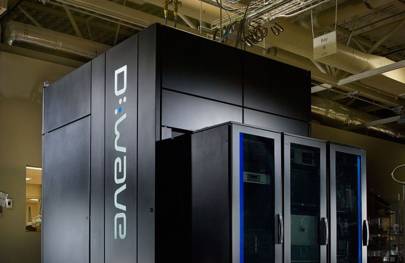
As of 2017, the development of actual quantum computers is still in its infancy, but experiments have been carried out in which quantum computational operations were executed on a very small number of quantum bits.[7] Both practical and theoretical research continues, and many national governments and military agencies are funding quantum computing research in additional effort to develop quantum computers for civilian, business, trade, environmental and national security purposes, such as cryptanalysis.[8] A small 16-qubit quantum computer exists and is available for hobbyists to experiment with via the IBM quantum experience project. Along with the IBM computer a company called D-Wave has also been developing their own version of a quantum computer that uses a process called annealing.[9]
One of the more fascinating developments in the Quantum Computing field is the fact that in December of 2017, Microsoft released a preview version of a "Quantum Development Kit".[10] It includes a programming language Q# that they have developed which can take advantage of the unusual and potentially incredible power of the Quantum Computer. The remarkable thing about this release is that there does not exist yet a quantum computer that can run programs beyond the trivial ones that can be run on the very small, experimental IBM and D-Wave quantum computers described in the previous paragraph. So as Lewis D. Eigen has said, "We can write, debug, and perfect quantum programs that not only cannot be run today, but might not be able to be run for a decade or more. The fact that Microsoft has invested substantial resources in a new language, and many programmers will actually write programs in that language that cannot now be run, is an indication of the enormous theoretical potential of quantum computing and the faith that someone soon will find a way to construct a large scale quantum computer. This is the future of computing, and Microsoft has given new meaning to the phrase 'getting ahead of the curve'." [11] To allow the "quantum programmers" to debug and see the results of their quantum programs, Microsoft has programmed a normal modern computer to behave like and simulate a quantum computer only it does not have the incredible speed that the real quantum computer will have when created. So quantum programmers will be creating their programs in "slow motion" until the development for which so many are awaiting.
Large-scale quantum computers would theoretically be able to solve certain problems much more quickly than any classical computers that use even the best currently known algorithms, like integer factorization using Shor's algorithm or thesimulation of quantum many-body systems. There exist quantum algorithms, such asSimon's algorithm, that run faster than any possible probabilistic classical algorithm.[12]A classical computer could in principle (withexponential resources) simulate a quantum algorithm, as quantum computation does not violate the Church–Turing thesis.[13]:202 On the other hand, quantum computers may be able to efficiently solve problems which are not practically feasible on classical computers.
In a world where we are relying increasingly on computing, to share our information and store our most precious data, the idea of living without computers might baffle most people.
But if we continue to follow the trend that has been in place since computers were introduced, by 2040 we will not have the capability to power all of the machines around the globe, according to a recent report by theSemiconductor Industry Association.
To prevent this, the industry is focused on finding ways to make computing more energy efficient, but classical computers are limited by the minimum amount of energy it takes them to perform one operation.
This energy limit is named after IBMResearch Lab's Rolf Landauer, who in 1961 found that in any computer, each single bit operation must use an absolute minimum amount of energy. Landauer's formula calculated the lowest limit of energy required for a computer operation, and in March this year researchers demonstrated it could be possible to make a chip that operates with this lowest energy.
It was called a "breakthrough for energy-efficient computing" and could cut the amount of energy used in computers by a factor of one million. However, it will take a long time before we see the technology used in our laptops; and even when it is, the energy will still be above the Landauer limit.
This is why, in the long term, people are turning to radically different ways of computing, such as quantum computing, to find ways to cut energy use.
What is quantum computing?
Quantum computing takes advantage of the strange ability of subatomic particles to exist in more than one state at any time. Due to the way the tiniest of particles behave, operations can be done much more quickly and use less energy than classical computers.
In classical computing, a bit is a single piece of information that can exist in two states – 1 or 0. Quantum computing uses quantum bits, or 'qubits' instead. These are quantum systems with two states. However, unlike a usual bit, they can store much more information than just 1 or 0, because they can exist in any superposition of these values.
"Traditionally qubits are treated as separated physical objects with two possible distinguishable states, 0 and 1," Alexey Fedorov, physicist at the Moscow Institute of Physics and Technology told WIRED.
"The difference between classical bits and qubits is that we can also prepare qubits in a quantum superposition of 0 and 1 and create nontrivial correlated states of a number of qubits, so-called 'entangled states'."
D-Wave
A qubit can be thought of like an imaginary sphere. Whereas a classical bit can be in two states - at either of the two poles of the sphere - a qubit can be any point on the sphere. This means a computer using these bits can store a huge amount more information using less energy than a classical computer.

Advances in quantum computing

Last year, a team of Google and Nasascientists found a D-wave quantum computer was 100 million times faster than a conventional computer. But moving quantum computing to an industrial scale is difficult.
IBM recently announced its Q division is developing quantum computers that can be sold commercially within the coming years. Commercial quantum computer systems "with ~50 qubits" will be created "in the next few years," IBM claims. While researchers at Google, in Naturecomment piece, say companies could start to make returns on elements of quantum computer technology within the next five years.
Computations occur when qubits interact with each other, therefore for a computer to function it needs to have many qubits. The main reason why quantum computers are so hard to manufacture is that scientists still have not found a simple way to control complex systems of qubits.
Now, scientists from Moscow Institute of Physics and Technology and Russian Quantum Centre are looking into an alternative way of quantum computing. Not content with single qubits, the researchers decided to tackle the problem of quantum computing another way.
"In our approach, we observed that physical nature allows us to employ quantum objects with several distinguishable states for quantum computation," Fedorov, one of the authors of the study, told WIRED.
The team created qubits with various different energy "levels", that they have named qudits. The "d" stands for the number of different energy levels the qudit can take. The term "level" comes from the fact that typically each logic state of a qubit corresponds to the state with a certain value of energy - and these values of possible energies are called levels.
"In some sense, we can say that one qudit, quantum object with d possible states, may consist of several 'virtual' qubits, and operating qudit corresponds to manipulation with the 'virtual' qubits including their interaction," continued Federov.
"From the viewpoint of abstract quantum information theory everything remains the same but in concrete physical implementation many-level system represent potentially useful resource."
Quantum computers are already in use, in the sense that logic gates have been made using two qubits, but getting quantum computers to work on an industrial scale is the problem.
"The progress in that field is rather rapid but no one can promise when we come to wide use of quantum computation," Fedorov told WIRED.
Elsewhere, in a step towards quantum computing, researchers have guided electrons through semiconductors using incredibly short pulses of light.
These extremely short, configurable pulses of light could lead to computers that operate 100,000 times faster than they do today. Researchers, including engineers at the University of Michigan, can now control peaks within laser pulses of just a few femtoseconds (one quadrillionth of a second) long. The result is a step towards "lightwave electronics" which could eventually lead to a breakthrough in quantum computing.

Quantum computing and space

A bizarre discovery recently revealed that cold helium atoms in lab conditions on Earth abide by the same law of entropy that governs the behaviour of black holes.
The law, first developed by ProfessorStephen Hawking and Jacob Bekenstein in the 1970s, describes how the entropy, or the amount of disorder, increases in a black hole when matter falls into it. It now seems this behaviour appears at both the huge scales of outer space and at the tiny scale of atoms, specifically those that make up superfluid helium.
"It's called an entanglement area law,” explained Adrian Del Maestro, physicist at the University of Vermont. "It points to a deeper understanding of reality” and could be a significant step toward a long-sought quantum theory of gravity and new advances in quantum computing